Home Blog Page 79

How to Hydrate Chickpeas

0

Things You\’ll Need

  • Bowl or jar

  • Colander

  • Stockpot with lid

... Chickpeas are full of antioxidents.

Chickpeas, also known as garbanzo beans, have a sweet, nut-like flavor. The beans are high in fiber, protein and iron. Chickpeas often are purchased dehydrated because it extends their shelf life, so you'll need to rehydrate them before eating or using them in a recipe. Soak the beans in water overnight if you have time, or rehydrate them quickly with the aid of boiling water. A single cup of dry chickpeas will yield 2 to 3 cups of cooked chickpeas.

Video of the Day

Overnight Soak

Step 1

Weigh the desired amount of chickpeas. Each 1 lb. of chickpeas will require 10 cups of water.

Step 2

Place the chickpeas in a bowl or jar. Cover them with cold water.

Step 3

Allow the chickpeas to soak for six to eight hours or overnight in the refrigerator.

Step 4

Strain the chickpeas to remove the water. Rinse the chickpeas.

Step 5

Cook the hydrated chickpeas immediately.

Quick Soak

Step 1

Pour 1 lb. of chickpeas into a stockpot.

Step 2

Add 6 to 8 cups of water to the chickpeas.

Step 3

Bring the water to a boil. Cover the pan. Boil the chickpeas for two minutes.

Step 4

Remove the chickpeas from the stovetop. Allow them to cool covered for one hour and no longer than three hours.

Step 5

Drain the water from the chickpeas. Rinse the chickpeas under cool running water.

Tip

After boiling the chickpeas, place them in the refrigerator overnight. This breaks down the sugars that cause gas.

If you cannot measure the chickpeas, the rule of thumb is to use twice the amount of water as beans.

Warning

Avoid adding salt to the chickpeas while they soak because it can toughen them.

How to Choose Spaghetti Squash

0

Cook a spaghetti squash, serve it hot with butter or olive oil and a bit of salt and pepper, and you've got a delicious and healthy vegetable dish with a subtle, slightly sweet flavor. You can even drizzle a bit of pasta sauce over it for a lower calorie substitute for traditional spaghetti. You can cook this unusual vegetable in many ways: baked, broiled, grilled or steamed. The most important step is to begin with a plump, fresh spaghetti squash.

Step 1

Choose a spaghetti squash with shiny, pale, lemon-yellow skin. If the squash is white or green, it's not ripe.

Video of the Day

Step 2

Pick up the spaghetti squash. It should feel fairly heavy in proportion to the size. Avoid overly large spaghetti squash, or squash that feels too light in comparison to its size, because it might be too old, tough and bitter. Spaghetti squash varies in size, but four pounds is about average.

Step 3

Purchase firm squash with no bumps, bruises, spots, soft spots or cracks. Avoid spaghetti squash with a dull appearance, which may be overripe.

Step 4

Put the spaghetti squash in the refrigerator as soon as you get home. Spaghetti squash is perishable, so don't store it any longer than five days, and don't wash it until you're ready to use it.

Instant Pot Apple Butter Recipe

0

eHow may earn compensation through affiliate links in this article.

Homemade apple butter is surprisingly easy to make! Despite the name, apple butter does not contain butter, making it naturally dairy-free and vegan-friendly. All you need to prepare apple butter is apples, cane sugar, brown sugar, and spices like cinnamon, nutmeg, and cloves. While apple butter can be made on the stove top or in a slow cooker, preparing it in an Instant Pot is a goof-proof method that comes together very quickly.

Video of the Day

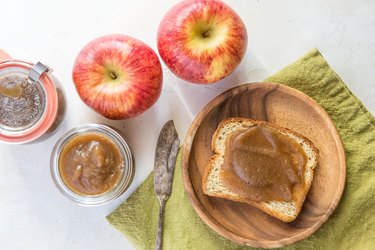
toast with apple butter and jars of apple butter Instant Pot Apple Butter Recipe Image Credit: Julia Mueller

Things You\’ll Need

  • Instant Pot

  • 3 pounds apples of choice

  • 3 Tbsp water

  • 1/2 cup cane sugar

  • 1/2 cup brown sugar

  • 1 tsp ground cinnamon

  • 1/2 tsp ground nutmeg

  • 1/4 tsp ground cloves

  • 1/2 tsp sea salt, to taste

  • 2 tsp lemon juice

  • 1 1/2 tsp pure vanilla extract

Step 1

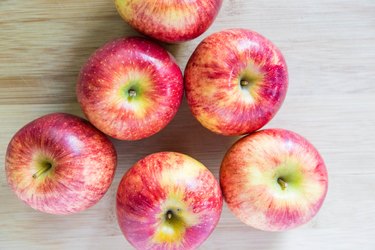
Use a vegetable peeler to peel the apples. Chop the apples into 1 to 2-inch hunks.

Apples on a cutting board Peel, core, and chop the apples Image Credit: Julia Mueller

Step 2

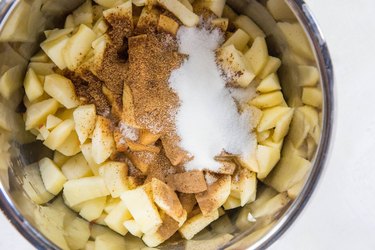
Transfer the chopped apples, water, sugars, spices, sea salt, lemon juice and vanilla extract (all of the ingredients) to your Instant Pot or pressure cooker.

Apple butter ingredients in an instant pot Add all ingredients to the instant pot Image Credit: Julia Mueller

Stir everything until well-combined.

Apple butter ingredients stirred in instant pot Stir apple butter ingredients together Image Credit: Julia Mueller

Step 3

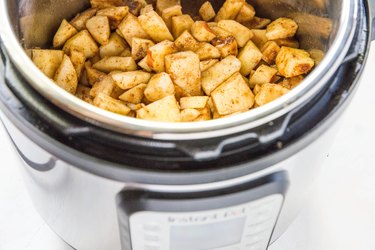
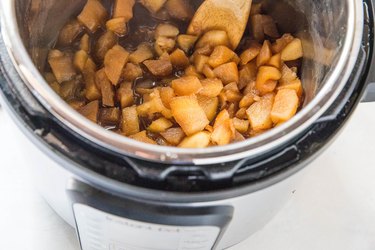
Secure the lid on the Instant Pot and press 'Manual' or 'Pressure Cook.' Set the time for 15 minutes and pressure cook on high. Make sure the steam release it set to 'Sealing.' Once the Instant Pot has finished cooking, allow it to naturally release the steam.

Once the steam has released, remove the lid of the Instant Pot.

Cooked apples in an Instant Pot Pressure cook on high for 15 minutes Image Credit: Julia Mueller

Step 4

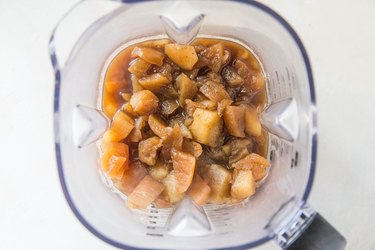
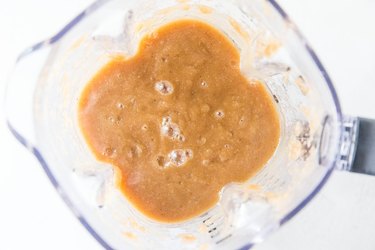
Use a potato masher to mash the apples, or an immersion blender to blend the apples to desired consistency. You can also transfer the cooked apples to a blender and blend until smooth (if you go this route, be sure the apples have cooled substantially before blending).

Apples in a blender Blend or mash apples to desired consistency Image Credit: Julia Mueller Apple butter in a blender Blend in a blender or use an immersion blender for smooth consistency Image Credit: Julia Mueller

Step 5

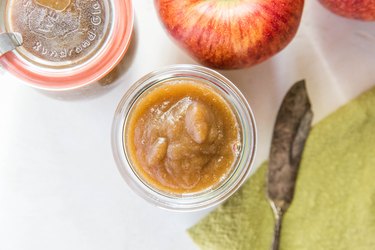
Pour the apple butter into sanitized jars and secure the lids. Refrigerate until chilled and ready to use.

Apple butter in jars Transfer apple butter to jars and refrigerate Image Credit: Julia Mueller

Easy One-Pot Butternut Squash and Sausage Pasta Recipe

0

One pot meals make for quick, easy, and affordable cooking. This One Pot Butternut Squash and Sausage Pasta recipe uses a minimal amount of basic ingredients and only requires about 30 minutes of cook time. For a comforting yet healthful meal, this pasta is a real winner!

Two plates of butternut squash and sausage pasta One Pot Butternut Squash and Sausage Pasta recipe Image Credit: Julia Mueller

Video of the Day

Things You\’ll Need

  • 3 tablespoons olive oil

  • ½ yellow onion, finely chopped

  • 6 cloves garlic, minced

  • ½ butternut squash, peeled and chopped (about 3 cups)

  • 4 ½ cups low-sodium chicken broth

  • ¼ cup dry white wine

  • 1(12-ounce) package penne pasta

  • 2 teaspoons Italian seasoning

  • ½ teaspoon sea salt

  • 1 (12-ounce) package pre-cooked chicken Italian sausage, sliced

  • 5 ounces baby spinach

  • 1 ½ cups Gruyere or Parmesan cheese, grated

Tip

  • Be sure to use pre-cooked sausage to keep the recipe simple and also eliminate any need for another pan for cooking.
  • Use any type of cheese in this recipe – Parmesan, Gruyere, or Gouda are recommended.
  • Replace the butternut squash with any winter squash or even sweet potato.
  • Substitute kale for spinach.
  • Make this recipe gluten-free by using gluten-free penne noodles.

Step 1: Cook the Vegetables

Heat the olive oil in a large pot over medium-high, and add the chopped onion. Saute, stirring frequently, until translucent, about 5 minutes. Add the butternut squash and garlic and cover. Continue cooking, stirring occasionally for 3 minutes.

Step 2: Add the Liquid and Pasta

Add the broth, white wine, Italian seasoning and sea salt to the pot with the veggies and bring to a full boil. Add the pasta and return to a boil. Cook uncovered, stirring occasionally, until most of the liquid is absorbed, about 12 to 14 minutes.

Step 3: Add the Spinach, Sausage, and Cheese

Once much of the liquid has been absorbed by the noodles, add the spinach and sliced pre-cooked sausage, and gently stir into the pasta until wilted.

pot of pasta with butternut squash, spinach, and sausage one pot butternut squash and sausage pasta Image Credit: Julia Mueller

Add the grated cheese and gently stir into the pasta until the cheese has melted and a thick, creamy sauce results.

Adding cheese to a pot of pasta Add the cheese to form a creamy sauce Image Credit: Julia Mueller

Step 4: Serve!

Taste the pasta for flavor and if necessary, add more sea salt and any fresh herbs if desired. Serve heaping plates with freshly grated Parmesan and enjoy.

Finished pot of butternut squash and sausage pasta One-Pot Butternut Squash and Sausage Pasta Image Credit: Julia Mueller

What Can I Substitute for Half & Half?

0

Cup of coffee Use table cream, coffee cream or evaporated milk in coffee. Image Credit: Creatas Images/Creatas/Getty Images

Whether you use half and half in your coffee or for a sauce or soup, making a substitute for it isn't difficult and you have several options to choose from. Fresh choices, such as cream and milk, offer versatility and taste more like half and half. Canned milk works too, especially if you chill it first. Choose a product based on what you're using it for.

Video of the Day

What It Is

Half and half is nothing more than a mixture of equal parts heavy cream and whole milk combined at a rate of one part each. Typically used in coffee, half and half contains 12 percent butterfat. It's not thick enough to whip, but it can replace heavy cream in sauces, baking and cooking.

Fresh and Fast

For an identical product, combine heavy cream and milk yourself to make a substitute for half and half. You can also use products labeled table cream, light cream or coffee cream, which contain slightly more butterfat than half and half. These substitutes work well for fresh use, such as pouring over fruit or oatmeal, as well as for baking, sauces and soups. Add a bit of milk to thin them down if you prefer.

Simple Solutions

For baking and cooking, combine milk and melted butter at a ratio of 1 1/2 tablespoons butter for every 7 to 8 cups of milk. Although this mixture won't taste like the real thing when used fresh, as in poured over fruit, it adds a creamy consistency when cooked in sauces and soups. Because regular milk has less fat than cream or half and half, it's more likely to curdle when heated. Add it to soups and sauces at the end of the cooking time and don't let it boil.

Shelf Stable

Evaporated milk also makes a fine substitute for half and half. Evaporated milk, not to be confused with sweetened condensed milk, is a canned product made by heating milk to remove 60 percent of the water. Evaporated milk has a thick, creamy consistency that works well in almost any application. When chilled, it can be whipped although it won't be as thick as heavy whipped cream. Evaporated milk is unlikely to curdle and can be used in soups, sauces and even the slow cooker. Use the same amount of undiluted evaporated milk as you would half and half.

How to Make Chalkboard Cookies

0

Transform traditional sugar cookies into tasty works of art with a personalized flair. Whether your designs are intricate, elegant or just plain cute, every bite really is worth a thousand words.

Chalk board cookies Sweet images Image Credit: Sonya Nimri

Video of the Day

Making the Cookies

Things You\’ll Need

  • 2 cups flour

  • 1/8 teaspoon salt

  • 1/4 teaspoon baking soda

  • 1 stick butter

  • 3/4 cup sugar

  • 1 eggs

  • 1/2 teaspoon vanilla extract

  • Cookie sheet lined with parchment paper

  • Plastic wrap

  • Cup

Step 1: Sift Dry Ingredients

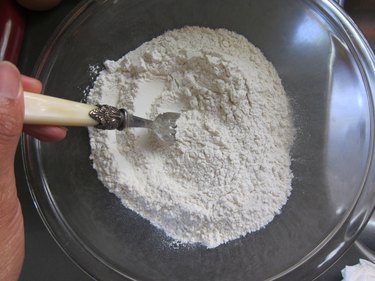
Sift the flour, salt, baking soda in a bowl.

Sift dry ingredients Mix dry ingredients Image Credit: Sonya Nimri

Step 2: Combine Wet Ingredients

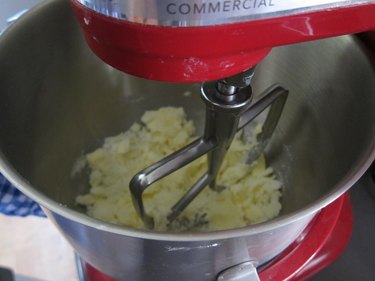
Cream room temperature butter and sugar until it is fluffy, then add egg and vanilla.

Cream wet ingredients Cream butter and sugar Image Credit: Sonya Nimri

Step 3: Add Dry Ingredients

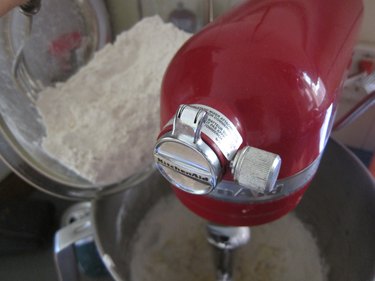
Add flour mixture until well combined. Form into a ball and wrap in plastic. Refrigerate for an hour until firm.

Combine with flour Combine with flour mixture Image Credit: Sonya Nimri

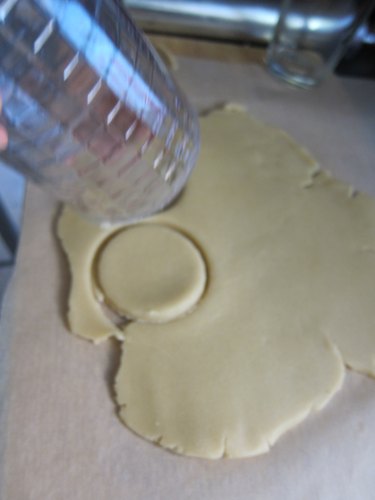
Preheat oven to 325 degrees. Refrigerate until firm, about 1 hour. Roll out with a rolling pin. Cut out shapes with a round cookie cutter or cup.

Cut out Roll out and cut into shapes Image Credit: Sonya Nimri

Step 4: Bake

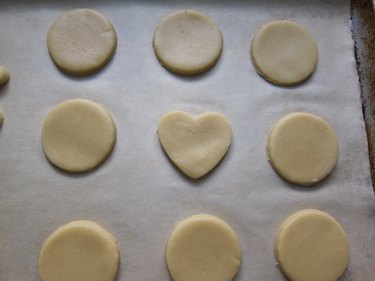
Transfer to a cookie sheet lined with parchment paper placing 1" apart.

Transfer to a cookie sheet Place on cookie sheet Image Credit: Sonya Nimri

Step 5: Let Cool on a Rack

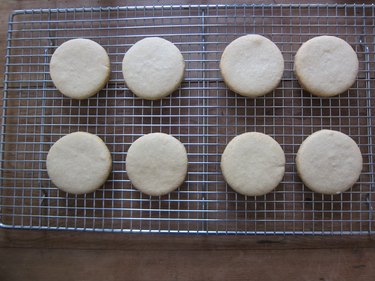
Bake for 10-13 minutes until slightly golden. Turn out onto a cooling rack. Let cool completely before icing.

Turn out onto a cooling rack Bake 10-13 minutes Image Credit: Sonya Nimri

Making the Icing

Things You\’ll Need

  • 2 cups powdered sugar

  • 1 egg white

  • Black food coloring

  • White gel paste food coloring

  • 2 tablespoons vodka (or water)

  • Various fine tipped brushes

  • Toothpick

Step 1: Separate Egg White

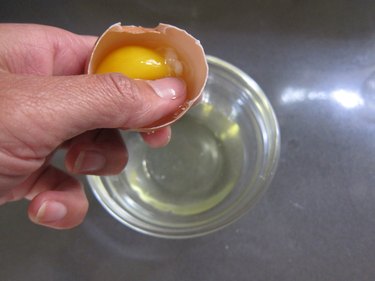
Separate an egg. Put the white in a bowl making sure not to get any yolk in the white.

Separate the yolk out Separate an egg Image Credit: Sonya Nimri

Step 2: Combine with Sugar

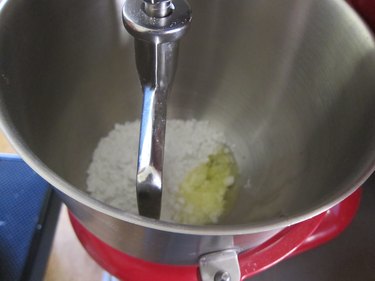
Combine the egg white with two cups powdered sugar in the stand up mixer with a paddle attachment on medium until thick yet runny like white glue.

Blend together Combine in a mixer Image Credit: Sonya Nimri

Step 3: Add Food Coloring

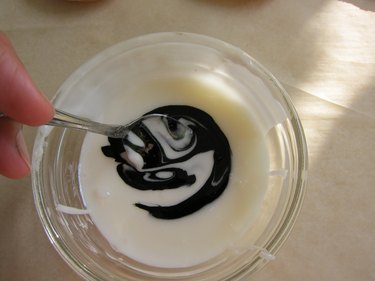
Add black food coloring. Mix well until all the icing is uniformly black.

Add black color Add color Image Credit: Sonya Nimri

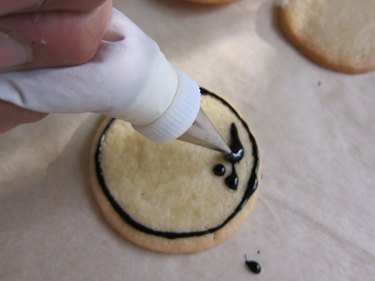
Pour icing into a piping bag with a #2 tip attachment. Pipe a circle 1/8" from the edge of the cookie then fill in the circle with icing.

Pipe black icing onto cookie Pipe icing onto cookie Image Credit: Sonya Nimri

Step 5: Pop Air Bubbles

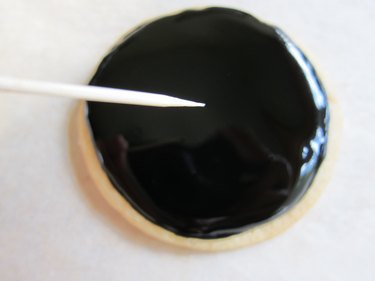
Pop air bubbles with a toothpick and let dry for at least 8 hours.

Poke any air bubbles Pop any air bubbles Image Credit: Sonya Nimri

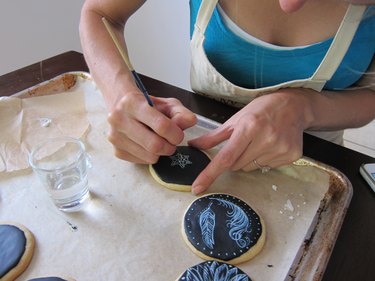
Squeeze a little white gel paste onto the parchment paper and with a fine tipped brush, paint the cookie. It is a good idea to practice on some of the cookies that didn't turn out so well first so you can get the hang of it before painting the best ones.

Decorate cookie Paint cookie Image Credit: Sonya Nimri

Step 7: Thin Paint with Vodka

Dip your paint brush in vodka to keep the consistency of the paint runny yet quick drying. You can also use water, but vodka dries faster, which sets your image quicker.

Use vodka or water to keep the paint at a good consistency Dip brush in vodka Image Credit: Sonya Nimri

Step 8: Display and Serve

Let the cookies dry for a few hours before serving. Keep for up to two weeks in an airtight container.

Cookies painted with a cat, owl and feather Display on a plate

Properties of Soft Drinks

0

...

Soft drinks, or soda pop beverages as they may be called, have long been criticized for providing no nutritional value and contributing to the global epidemics of diabetes and obesity. However, the popularity of these drinks have continued to rise in the face of health concerns.

Video of the Day

Caffeine

Mountain Dew and Mellow Yellow contain the highest levels of caffeine amongst popular soft drinks, at 54 and 53 milligrams, respectively. Dr. Pepper, Pepsi and Coca Cola aren't far behind, while Sprite, 7-Up and Fanta have zero milligrams of caffeine. As a comparison, regular brewed coffee has between 95 and 200 milligrams.

Sugar

The sugar content of most soft drinks is between 30 and 60 grams. The United States Department of Agriculture (USDA) recommends adults eating 2,000 calories per day consume no more than 40 grams of sugar per day. In North America, soft drinks are often sweetened with high fructose corn syrup, which many health experts believe does even more damage than sugar, especially when consumed in high quantities.

Artificial ingredients

Artificial sweeteners, flavors, colors and preservatives are present in most soft drinks. Citric or phosphoric acids are generally used to give a tart flavor and prevent the drinks from spoiling. These acids can cause your body to leech calcium from your bones in order to stabilize the pH of your blood, so chronic soda drinkers are vulnerable to developing osteoporosis.

Sweeteners like aspartame and Sucralose are frequently used in diet soft drinks, and experts are divided on whether or not people should make a habit of consuming them. Studies have shown that consuming either regular or diet drinks can increase your risk of metabolic syndrome by 44 percent. Additionally, lab tests have demonstrated an increased risk of cancer in lab rats consuming aspartame, although this risk has not been proven in humans.

The History of Beer Bottles

Beer bottles have a distinctive shape that sets them apart from other beverages, and even other alcoholic beverages. The history of the beer bottle to its present short- and long-necked versions is long and glorious–much like the beverage it contains.

1800 B.C.

The first record of beer was in Sumer, which is located between the Tigris and Euphrates Rivers. The Sumerians recorded the process of making beer on clay tablets. The first beer bottles were jars out of which the Sumerians drank their beer with a straw.

Video of the Day

1700s

It was not until the 1700s that glass bottles for beer began to be used, and these glass bottles were much the same bottles that held wine and other alcoholic beverages. The glass of the bottles was black and thick. As twist-off or crown caps were not yet invented, corks stoppered these beer bottles.

Late 1700s

Toward the end of the century, the beer bottle began to grow more distinctive, taking on a low-shouldered shape. While the necks of the wine bottles remained long, by comparison the beer bottles' necks were shorter. This shape of beer bottle gained the name "porter."

Late 1840s to 1850s

With the development of a new style of beer in America called lager, a new style of beer bottle developed. The first early lager bottles had a shape one associates with today's mineral water bottles–with very sloped shoulders and longer necks. By the 1850s, ale and lager shared the same shaped beer bottles, which were like the beer bottles of the late 1700s.

1870s

In the 1870s, another style of beer bottle made its appearance: the champagne beer bottle. This bottle was pressed into duty for champagne, beer, root beer and small beer. Its shape resembles a modern-day wine bottle, as the body of the bottle is narrower than that of the beer bottles that came before it.

1860s to 1880s

Three so-called weiss beer bottle shapes appeared in the 1860s to the early 1880s. The weiss beer bottle of the 1860s and the Zaun weiss of the 1880s were nearly identical, with the earler version possessing a slightly longer neck. The St. Louis weiss beer bottle of the 1880s had the longest neck of all and resembled the early lager shape beer bottle, except that its body was narrower and the neck longer. All three of these heavy bottles held the German brew, weiss, a wheat-based, foamy beer.

1860s to 1890s

The early export beer bottle shapes were very similar. Generally speaking, these bottles had wider bodies and long necks with ridges on them. Although these bottles were mostly used for export beer, some domestic beer was bottled in them also. Beer bottles for flavored beer made their appearance during this time as well, although the capacity of these bottles was lower than that of the export bottles. The flavored beer bottles also held champagne and root beer as well as Cronk's beer. The malt porter shape resembled the export beer bottles, and was used to bottle malts as well as beer.

7 One-Pot Recipes to Make Your Life Easier

0

Weeknights can be a challenging time. When you're drained from a long day, putting dinner on the table can be a real chore. Eating out and ordering in are options, but they get expensive in a hurry and those meals often aren't always as healthy or fresh-tasting as homemade. To help you with that nightly challenge, here are seven of our favorite one-pot recipes.

7 One-Pot Recipes to Make Your Life Easier

Video of the Day

1. Gumbo Pasta

Authentic, traditional gumbo is a thick, rich-tasting stew that simmers for hours before being served over a bed of rice. It makes for a genuinely memorable meal, if you have the time to invest in it, but it usually takes hours and some steps along the way — like making the dark roux — require extended, hands-on attention. This easy one-pot gumbo combines all of those traditional flavors, and substitutes pasta for the rice, to create a version that's ready and on your table in just 30 minutes.

Stainless steel pot full of "gumbo" pasta on a stove top, stirred by a wooden spoon. Gumbo pasta is faster than the original, but just as tasty. Image Credit: eHow

2. Vegan Chili

Chili is one of the world's great comfort foods, whether in its original form as an all-meat dish or in the more common version that's fortified with beans. The basic dish is infinitely variable, and as long as you've got all the right seasonings, it will still taste like chili. That's true even if you leave out the meat entirely, as we do in this genuinely appealing vegan chili. All of the flavors are perfectly traditional, and the chopped mushrooms do a fine job of replicating the texture of ground beef.
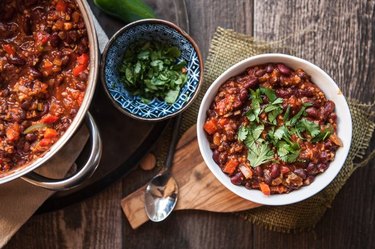
Overhead view of a pot of chili and bowl of chili sitting on separate trivets, with a bowl of chopped green herbs between them. Even meat-eaters can get behind a good vegan chili. Image Credit: eHow

3. Butternut Squash & Sausage Pasta

On cold or rainy days, it's nice to have a hearty, warming pasta-based casserole to put on the dinner table. Unfortunately, those take time to prepare, and assembling one typically includes several steps and generates a lot of dirty dishes along the way. It's much simpler to combine the same kind of ingredients — pasta, vegetables, cheese, savory meats and creamy sauce — into a stove top dish, like this butternut squash and sausage pasta. It's just as comforting as your favorite casseroles, but with a lot less work and cleanup.

Overhead view of two bowls of penne with sausage and squash, on a wooden table surrounded by a kitchen towel and the dish\'s ingredients. Squash, sausage and pasta combine in a hearty, simple and tasty meal. Image Credit: eHow

4. Creamy Tortellini Soup

Canned soups are one of the all-time great convenience products. Most traditional soups take time to make, and many cooks argue that they don't really taste right until they've had a chance to sit overnight, so the option of putting soup on the table in just minutes is pretty appealing. Unfortunately, canned soups aren't terribly filling, and they're also not known for their fresh flavors. If you want a quick soup that's loaded with flavor and more of a meal, this creamy tortellini soup might just hit the spot. Made with flavorful canned tomatoes and quick-cooking fresh tortellini, it only takes about 20 minutes from start to finish.
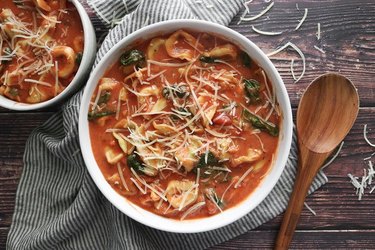
Overhead view of tortellini soup in white bowls, with a wooden spoon and kitchen towel alongside. A hearty, full-flavored soup can be a meal in itself. Image Credit: eHow

5. One-Pot Stroganoff

A traditional beef Stroganoff calls for strips of steak in a savory, mushroom-y sauce with plenty of sour cream added at the end for a savory tang. This easy one-pot Stroganoff updates the classic version to make it easier and faster. It calls for quick-cooking ground beef instead of the steak strips, and instead of serving the dish over egg noodles that have been cooked separately, it prepares the noodles right in the pan. Not only is it convenient, it provides a chance for the noodles to absorb flavors from the broth as it cooks. Plain yogurt is a non-traditional finishing touch, providing a sour cream-like tang with less fat and fewer calories.

Three-quarter view of one-pot stroganoff in a pot, being stirred by a wooden spoon. One-pot stroganoff is faster and easier than the classic version, but just as tasty. Image Credit: eHow

6. Creamy Tomato Basil Chicken Pasta

Ladling sauce over plates or bowls of pasta is a satisfying ritual, but it's inefficient — more pots to wash! — and if you care about that sort of thing, tossing the pasta and the sauce ​before​ serving is more authentically Italian. Our one-pot tomato basil chicken pasta is exactly the kind of dish that's perfect for busy weeknights, coming together in just minutes with minimal effort and maximum flavor. It's rich and hearty and satisfying, and you definitely won't miss washing those extra pots and pans.

Two white bowls containing pasta, on a white countertop with forks, fresh basil and a kitchen towel. Chicken, pasta, tomatoes and fresh herbs. What\’s not to like? Image Credit: eHow

7. One-Bowl Peppermint Brownies

No dinner is really complete without an appropriate dessert. So what goes with a one-pot meal? Why, a one-bowl dessert, of course. These peppermint brownies follow a simplified method that starts with melting chocolate in a bowl big enough to handle the entire batch of batter. The rest of the ingredients are added in a specific order to create a thick, rich batter. The finished brownies have a topping of melted chocolate and crushed peppermint candies, the perfect complement to the brownie itself.
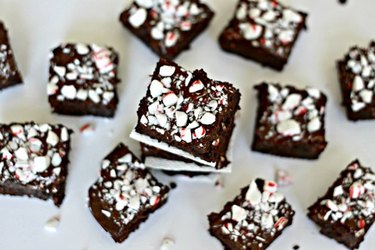
Overhead view of peppermint-topped brownies on a white work surface. What follows a one-pot meal? A one-bowl dessert, of course! Image Credit: eHow

How to throw the perfect mocktail party

Mocktails are just what it sounds like–mock cocktails. There are many opportunities to throw a mocktail party. You can create a fun and festive event without the added alcohol. Mocktail parties can be just as fun as cocktail parties if you approach the event in a fun and entertaining way. Throwing a perfect mocktail party involves planning, creativity, great drink recipes and decorative glasses and napkins. Read on to learn how to throw the perfect mocktail party.

Step 1

Choose an event that would complement a mocktail party. Maybe a going away lunch for a co-worker or a friend of yours is pregnant and you want to throw her a baby shower. These would be good opportunities for a mocktail party. A mocktail party is a good choice when you want to add a special pizazz to a party but you don't want to include alcohol.

Video of the Day

Step 2

Choose an array of specialty drink recipes. There are some great fun and fruity flavored recipes for cocktails but you just want to leave out the alcohol. Select at least three different recipes. For example, try a a virgin frozen daquiri, a virgin margarita and soda water with fresh lemon or lime. By choosing at least three different recipes chances are you will have something that will appeal to each of your guests.

Step 3

Serve each of the drinks in festive colored glassware with some type of decorative item such as a toothpick paper umbrella or a mermaid. Choose something that will coordinate with the rest of the party. Serve the drinks on a party tray to add to the festive mood. Use coordinating napkins. Serve the mocktails to your guests and also leave a "bar" available for them to help themselves.

Step 4

Play good music. One of the reasons it seems alcohol is served so often at parties is alcohol seems to make some people feel more relaxed. If you key up a creative play list before the party starts you will help set a relaxing but fun atmosphere for the party. Your guests will mingle and indulge in good conversation in no time. You will be on your way to throwing a perfect mocktail party.

Step 5

Finally, plan a party game. Make sure the game is simple because it is meant only to be an ice breaker. For a baby shower you could collect baby safety pins in a large glass container and offer a prize to whoever guesses the right number. You could have trivia cards around the room and encourage guests to ask each other questions from the list. Tailor the trivia to the type of party you are having. By planning a party game to serve as an ice breaker you get your guests involved in something fun.

Step 6

Keep your mocktails fresh and well stocked. A blended drink will need to be kept chilled. A soda water with fresh lime will need available ice. Offer to re-fill your guests drinks for them. Keep the party going in a positive up-beat direction.

Tip

Make sure you let your guests know that this will be a mock-tail party on the invitation. Plan the party for early to late afternoon when most people aren't expecting to be served alcohol.